
A “new inquiry” from CheckinPort: misleading inquiries to chalets and guesthouses
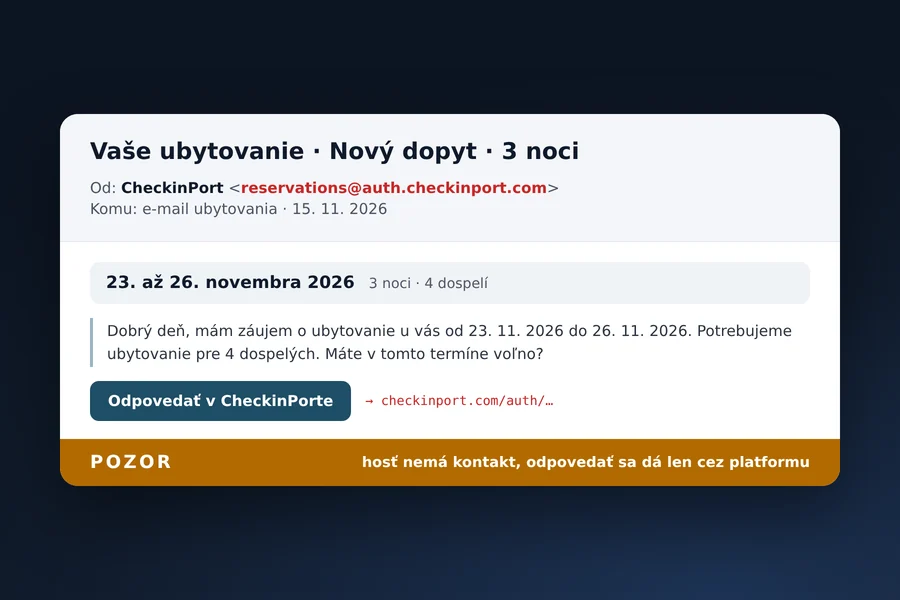
The inquiry as it reached an accommodation on 15 November 2026. We removed the property name; the link in the image is plain text.
Two accommodation providers whose website and email we look after received an almost identical email within two days. The first one got it on Sunday 15 November, the second, a chalet, on Monday 16 November in the early evening. The sender is CheckinPort, the subject reads “property name · Nový dopyt · number of nights” (Slovak for “new inquiry”).
The first email said this (translated from Slovak):
Hello, I am interested in staying with you from 23. 11. 2026 to 26. 11. 2026. We need accommodation for 4 adults. Do you have availability on these dates? Thank you.
The second one, signed by a Ms Maláková:
Hello, I wrote to you yesterday evening, in the end our plans changed and we would like to come from Sunday already if you have availability. Thank you for your reply.
In both cases there is a single button below the text: “Odpovedať v CheckinPorte” (“Reply in CheckinPort”). No guest email address, no phone number.
Update 18 November 2026: CheckinPort’s statement
The operator of CheckinPort, Globalio LLC, sent us a statement on 18 November. It says that an inquiry from one person may have been distributed to multiple accommodation providers, that it has removed this functionality and that it apologises to the affected providers. It rejects that it fabricated inquiries and says that it has removed the 297 € fee and that registration and replying to inquiries are free. However, its terms published on checkinport.com still state, as of 18 November 2026, a one-time fee of 297 € for access. We have revised the article so that it clearly separates the facts we documented from our own assessment.
What we found
Two inquiries like carbon copies. Two properties that have nothing to do with each other received, in the same week, an inquiry for the end of November, 3 to 4 nights, 4 adults. The text is short, polite and could be sent to anyone. The second email adds pressure: the guest supposedly wrote yesterday already, so not replying would feel rude.
The guest can only be reached through the platform. A real person looking for a chalet writes to the address on your website or calls you. Here the only way to reply is through someone else’s website.
The platform is paid. According to CheckinPort’s terms (effective 1 October 2026, as of 18 November 2026), an accommodation provider pays 297 € once for access, plus 2 % of direct bookings and the fees of the payment service Stripe. According to CheckinPort, registering and replying to an inquiry are free. In our view the inquiry mainly serves to get the owner onto the platform.
The platform appeared three months ago. The domain checkinport.com was registered on 25 August 2026 with the US registrar Name.com. The website runs on Vercel hosting. According to the terms, the operator is Globalio LLC at 16192 Coastal Hwy, Lewes, Delaware. That is a registered agent address used by thousands of companies without a real office. For accommodation providers as businesses, the terms apply Delaware law and courts.
They claim thousands of properties. The home page lists 9,571 properties in Slovakia, Czechia and Poland. If you never added yourself to CheckinPort and still receive “inquiries” with the exact name of your property, they got your details from somewhere else. CheckinPort’s privacy policy lists only users, accommodation providers, booking forms and linked calendars as data sources, not public websites or portals.
An “American” company operating from the EU. According to its terms, CheckinPort is operated by Globalio LLC, registered in the US state of Delaware. The same company lists on its website a portfolio of further projects with the same “no monthly fees” model, among them the fitness-centre payment platform Fitliner.eu and the Slovak e-shop TOPsara.sk. Globalio’s main domains run on the Slovak nameservers of WebSupport and its sites are in Slovak. The Delaware address is a registered-agent address shared by many companies. For an accommodation provider this means one thing: this is not an unreachable company from across the ocean. The platform targets the Slovak, Czech and Polish market and processes data about properties in Slovakia, so it is subject to the GDPR and to the oversight of the Slovak Office for Personal Data Protection.
The email tracks whether you opened it. It contains a hidden image that tells CheckinPort the address works and someone reads it. The link in the button is personal and valid for a month.
We found no reviews or experiences with CheckinPort anywhere online. A platform handling bookings for thousands of properties would have them.
How to spot a suspicious inquiry
- It came through a platform you are not on. If you never registered somewhere, no real guests can reach you from there.
- The guest has no email or phone number. You can only reply with a button on someone else’s website.
- The text fits any property. Dates, number of people and a polite question, nothing about your place.
- Urgency. “I wrote to you yesterday”, “our dates changed”, so that you react quickly.
- An unknown platform with no reviews. A few minutes of searching tells you whether anyone knows it.
Pressure to reply quickly is worth watching for in any email. How it looks with domains, for example, is described in our article on an email from a “Chinese domain registry”.
What to do with such an email
Do not click the button and do not register. If you want to be sure it is not a real guest, check the mail from your own website and the booking portals you are actually on. A real guest will find you there.
Do not connect Booking.com or Airbnb to CheckinPort. The platform offers to link these portals. Do not give access to the account that holds your reservations, guests and payouts to a service you did not choose yourself.
Mark the email as spam. Further inquiries from CheckinPort will then stay out of your inbox.
Ask for deletion. Write to info@checkinport.com that you do not want to register, ask them to delete the data about your property and about you, and ask where they got it. If you run your accommodation as an individual, the GDPR gives you that right. What the regulation means in practice is summarised in our article GDPR and IT for businesses.
If you already paid, contact your bank right away and ask for a card payment dispute. If you entered a password on CheckinPort that you also use elsewhere, change it everywhere you use it. The steps are in our article What to do when your account gets hacked.
How to recognise scam emails in general is covered in Phishing: scam emails.
Got a similar inquiry and not sure about it?
Send it to us and we will look at where it came from.
Get in touchVerification and sources. We worked from two emails from CheckinPort delivered on 15 and 16 November 2026 to accommodation providers we work with. We do not name them. We checked the domain checkinport.com in the public domain registry (RDAP) and in DNS. The operator, prices and data sources come from the terms and privacy policy on checkinport.com; we checked the terms again on 18 November 2026. Information about the operator and its other projects comes from the public websites globaliollc.com and fitliner.eu and from public domain data (DNS and nameservers), verified on 19 November 2026. We did not click the buttons in the emails and did not reply to the inquiries.
This article is part of the Cybersecurity overview.
Comments and questions 0
We keep the discussion to the point. Ads, links to other services, profanity and personal attacks will not be published. Neither will posts containing other people's personal data.
Frequently asked questions
I got an email from CheckinPort with a new booking inquiry. Is it real?
What is CheckinPort?
I clicked “Reply in CheckinPort”. Did anything happen?
Should I connect Booking.com or Airbnb to CheckinPort?
How do I get off CheckinPort?
I paid 297 €. Can I get my money back?
Need help with IT?
We will take care of your computers, networks and security - for businesses and households in the Liptov region.
Contact us