
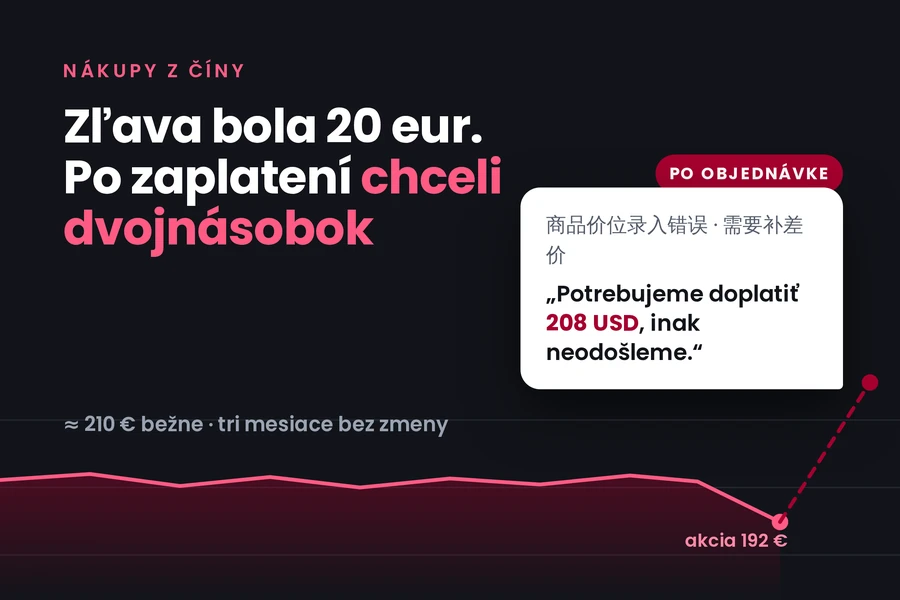
We watched the price for three months. After we paid, the AliExpress seller wanted double
Screenshots and analysis: tiptech.sk, based on a real order from 17 October 2026
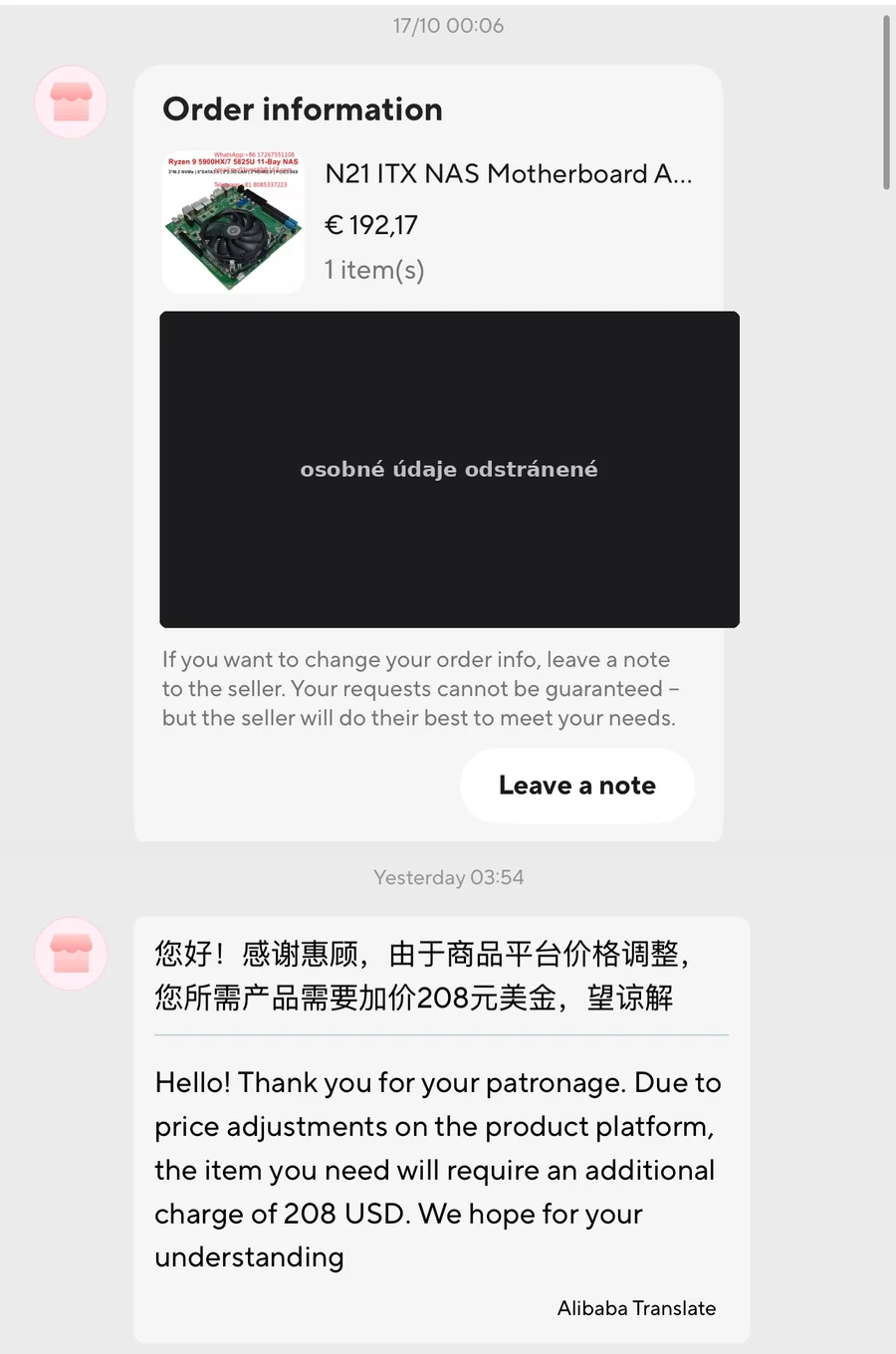
On 17 October we ordered a motherboard for a NAS. Nothing exotic: a regular ITX board with a mobile Ryzen and eleven drive bays. On sale at 192.17 euros, roughly twenty euros below what the listing normally charged.
The order went through, the payment cleared, the shop accepted it.
Two days later, at 3:54 in the morning, a message arrived.
Hello! Thank you for your patronage. Due to price adjustments on the product platform, the item you need will require an additional charge of 208 USD. We hope for your understanding.
Two hundred and eight dollars is roughly what the item itself cost. So having taken our money, they wanted double.
Two messages, two different reasons
The first message blamed “price adjustments on the product platform”. We wrote back that we were not paying it. The reason promptly changed:
Hello, I’m really sorry! After reviewing the order after it was placed, we discovered that the product price was entered incorrectly. If you are willing to continue arranging the shipment, an additional $208 USD will be required to cover the price difference. You can consider it, and if you can accept it, I will create a link to cover the difference for you; if not, the order can be canceled.
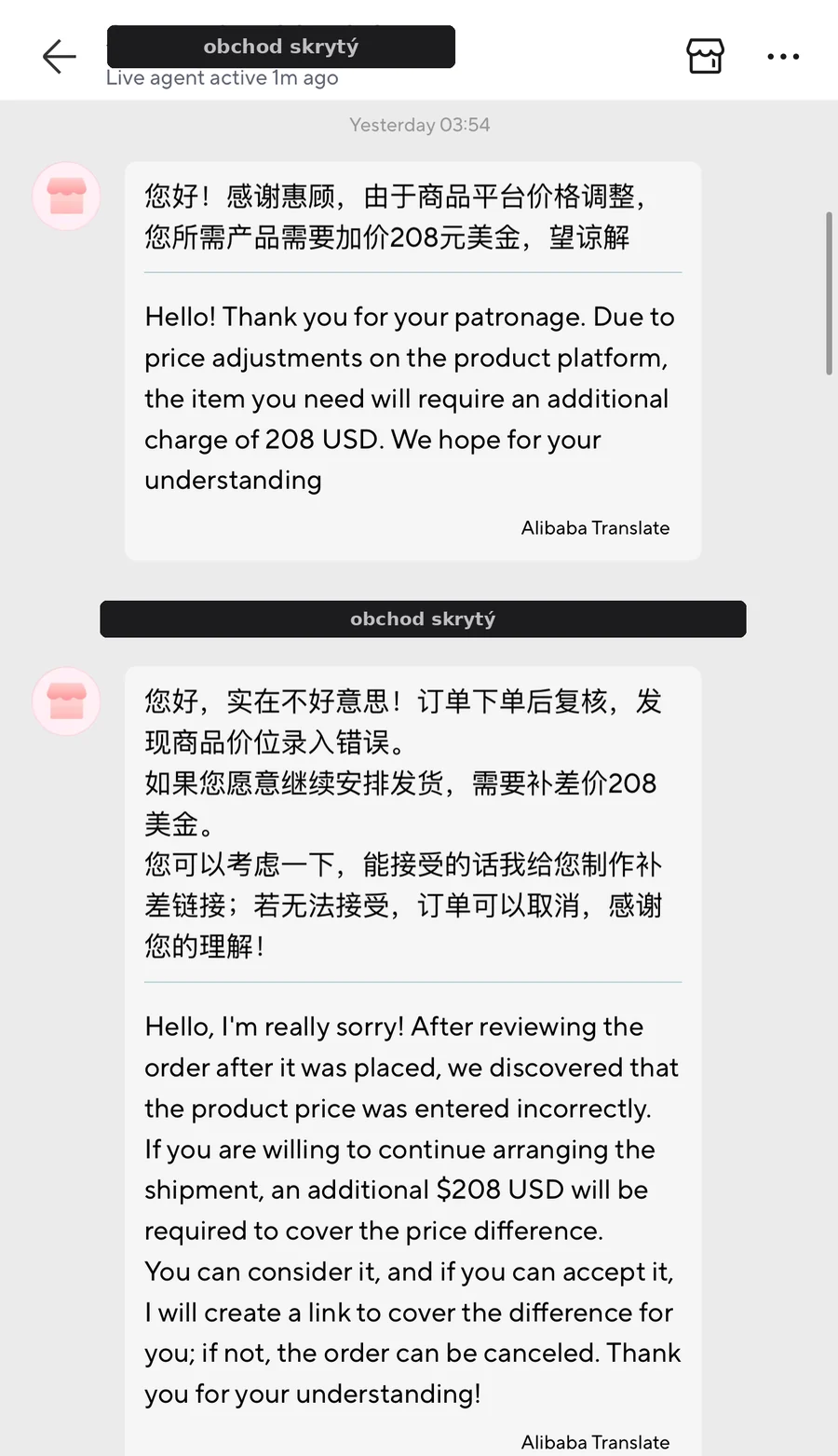
So first it was the platform and its “price adjustments”, moments later their own typo when entering the price. Two different things that cannot both be true. When the reason changes depending on how you react, it usually means you never heard the real one.
There is one more thing in that message we missed on the first read: the offered link to cover the difference. Not an adjustment to the original order, but a separate payment alongside it. Exactly the kind of payment that does not carry the same buyer protection as the original order.
If the goods then failed to arrive, we would get the original 192 euros back. Those 208 dollars, far less easily.
Why the typo story does not hold
We had been watching that listing for about three months, waiting for the price to come down to a level where the purchase made sense. Throughout that time it held at around 210 euros. We bought it on sale at 192.17 euros, so about twenty euros below its usual price.
And it is those twenty euros that break the typo story.
Had the price been entered by mistake, it would differ from the real one by an order of magnitude. A missing zero, a misplaced decimal point, something of that kind. But the usual price was set by that same shop, and for months it sat at around 210 euros. We paid twenty less, while the surcharge they asked for is ten times that discount.
Typos also do not behave like this. A typo is a mistake a shop notices with the first order and fixes the same day, because otherwise it loses money on every further unit.
Nothing about that listing looked like a trap. No half price, no countdown to the end of a sale. An ordinary price that had not moved in months, followed by a modest discount. That is exactly what gets past someone who compares and does not rush into things.
The demand for extra money comes only once your money is tied up in the order. At that point you are no longer deciding whether to buy. You are deciding whether to pay up or start the whole search again. Some people pay at that point, and that is the entire purpose.
The seller wrote that they are not allowed to do it
We wrote back again, this time in detail: we were not paying the difference, we had watched the price for months, and it did not look like a typo.
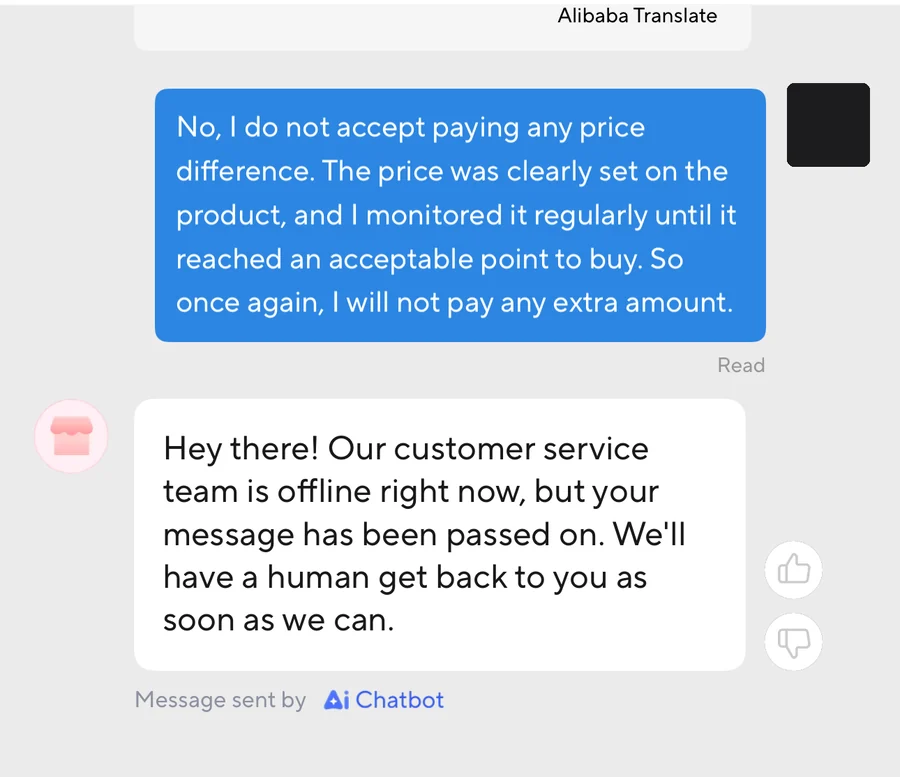
This is what they wrote back:
I understand your frustration and I sincerely apologize for the confusion regarding the price. You are absolutely correct that under platform policies, sellers cannot unilaterally change the price or demand extra payment after an order is placed and paid for.
That admission was followed by a “however”. This was supposedly a genuine clerical error, shipping at the original price was therefore impossible, and so the only viable solution was to cancel the order.
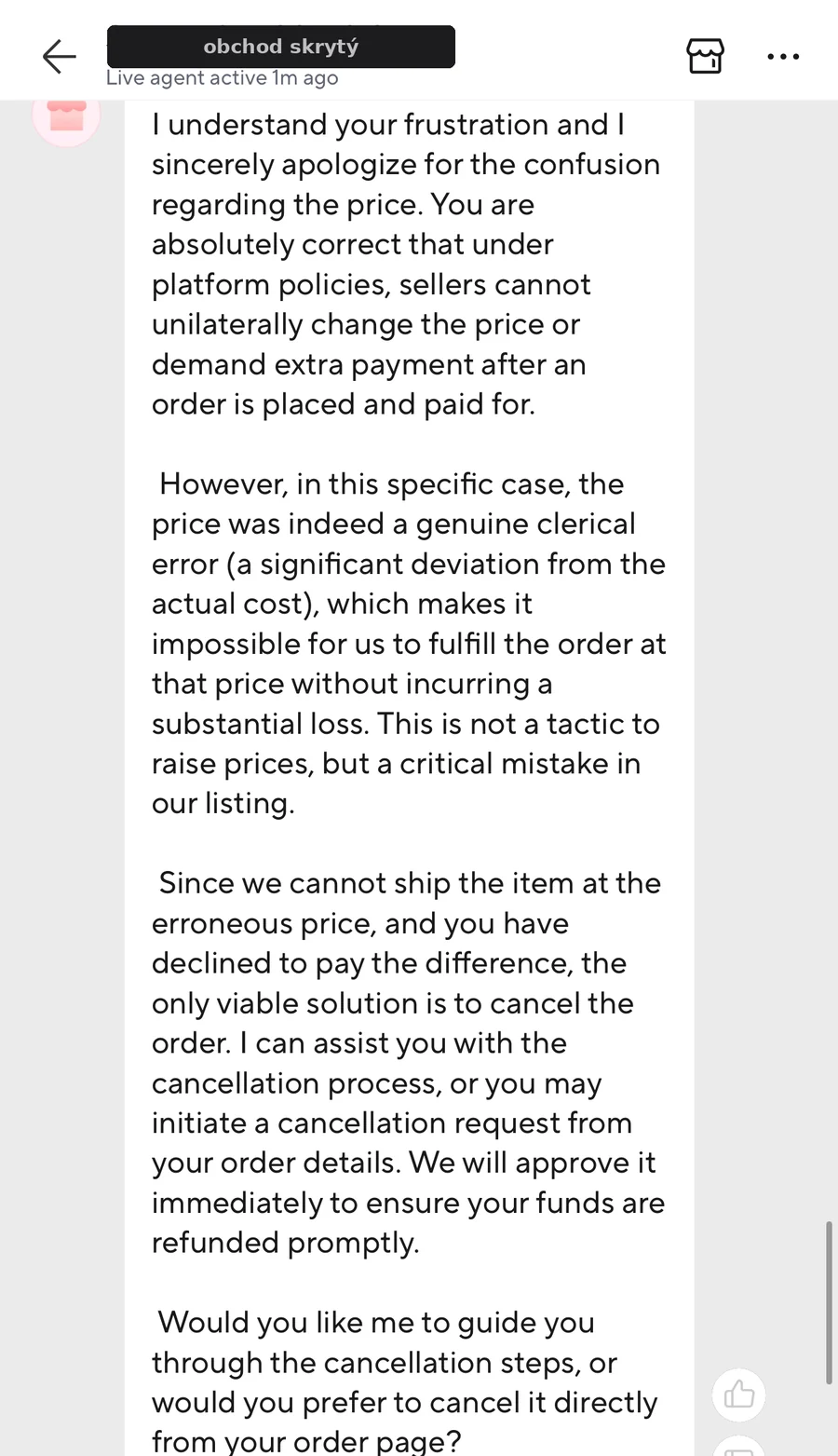
So in one message the shop confirms that what it is doing is against the rules, and in the same message it carries on doing it. That is hard to pass off as a translation mix-up.
The real trick is who cancels the order
The worst part is how the conversation ends:
I can assist you with the cancellation process, or you may initiate a cancellation request from your order details. We will approve it immediately to ensure your funds are refunded promptly.
It sounds helpful, and it is at the same time exactly what the seller needed from the start.
If the seller cancels, or the shipping deadline passes with nothing sent, the platform records it as their failure. It calls this transaction non-fulfilment, meaning the seller did not ship within the required time frame after payment. Breaches are graded by severity and earn points that affect the account and the shop’s visibility.
If the buyer requests the cancellation, it is recorded as a buyer-side cancellation. The seller clicks approve and nothing is left in their statistics.
So you get your money, the shop cleans up its record, and the low price stays up for the next person in line. The only thing it still needs is your consent.
What the AliExpress rules actually say
The terms for EU and EEA consumers say that you enter into a relationship with Alibaba.com Singapore E-Commerce Private Limited, and that the order comes into being when it is submitted and accepted with the agreed terms, including price and quantity. Nowhere does it say the seller may raise the price after payment. Under those same terms you may cancel a transaction where you are exercising rights under consumer protection law or where the law allows it, so cancellation is not a lever the seller pulls whenever the price stops suiting them.
Failure to ship has its own term in the seller rules. Transaction non-fulfilment means failing to ship within the required time frame after payment, and failing to upload a tracking number before the deadline counts as failing to ship. It is split into violations, serious and very serious, each carrying points.
What we could not find published as a separate numbered rule is an explicit ban on asking for extra payment. So we will not claim more than we can evidence: the ban was confirmed to us by the shop’s own support, and refusing to ship a paid order is something the rules do penalise.
What to do if it happens to you
- Do not pay the difference. Not through a top-up link, not by any other route. You would give up the advantage of having the platform hold your money.
- Do not cancel the order. This is the one step that cannot be undone and the one the shop needs from you. Not even when it promises instant approval and a fast refund.
- Reply in the chat, and say it clearly. One sentence stating that you are not paying extra and that you insist on shipment at the agreed price. The AliExpress chat is part of the order and can be referred back to in a dispute.
- Check the shipping deadline in the order details. That is the time by which the seller must upload a tracking number. If they do not, the order cancels itself once it expires and the money goes back. The difference from you cancelling is that this one counts against the shop.
- Expect a fake tracking number. Some sellers in this situation upload a tracking number for a parcel that never moves, purely to stop the clock. If that happens, wait for the delivery deadline to pass and open a dispute on the grounds that the item never arrived.
- Take screenshots before you need them. The whole conversation, the order details and the original price in the listing. Conversations can be deleted and listings can be edited or pulled at any time.
- If the dispute goes badly, there is still the card. If you paid by card, you can dispute the payment with your own bank. It exists for cases where the goods never arrived and the seller did not refund, which is exactly why a card is the payment method worth using here.
And one more thing that costs nothing: rate the seller and describe briefly what happened. The next person looking at that listing will see it before they pay.
How to spot it before you pay
You cannot avoid it entirely, but a few things keep coming up.
Look at what everyone else charges for the same item. With components the spread tends to be narrow, because the seller has to buy the item somewhere too, so a listing far below the whole field is not a win, it is bait. The same goes for a shop with no history, meaning a name like Shop followed by a long number, a short track record and a handful of ratings.
The product photo is worth a look too. The picture of the board in our order has a WhatsApp number and a Telegram number added to it, which is an invitation to leave the platform. Off it you lose every protection you have, and that is the whole point.
It happens most with motherboards, processors, graphics cards, drives and mini PCs. Anywhere the item is expensive, prices are easy to compare, and a few hundred euros make the attempt worth it for the shop.
And what about the law
Slovak and European consumer law will not help you much when buying from a Chinese seller, even though the platform formally addresses European customers and does publish separate terms for EU consumers. Under those terms you enter into a relationship with a Singapore company, and disputes are handled first inside the platform’s system and potentially in arbitration in Hong Kong. Enforcing anything directly against a shop in China is, in practice, out of reach.
Your leverage sits in two things, and neither of them is legal: the platform holds the money until the goods arrive, and a card payment can be disputed with your own bank. That is exactly why step two above matters so much. Cancel the order yourself and you throw both of those away voluntarily.
Conclusion
We did not pay the difference and we did not cancel the order. Not because one motherboard worth two hundred euros is worth the fight, but because a cancellation in your name is the only thing that shop genuinely needs from you. Let its shipping deadline run out instead, and let it have that on its own record.
Building a NAS or a server and unsure about an offer?
We will advise on the components, build the storage and set it up, backups included. Instead of hunting for the lowest price you get a build that will work for years. For homes and businesses in the Liptov region, elsewhere remotely.
Get in touchVerification and sources. All quotations come from the conversation attached to an order placed on 17 October 2026. The screenshots are original; we removed only personal data and the shop name. We deliberately do not name the shop, because this is not one listing but a recurring pattern. The platform terms are taken from AliExpress.com Terms and Conditions for Platform Transactions by EU/EEA/UK Consumers, and the transaction non-fulfilment rule from the AliExpress seller rules.
This article is part of the Cybersecurity overview.
Comments and questions 0
We keep the discussion to the point. Ads, links to other services, profanity and personal attacks will not be published. Neither will posts containing other people's personal data.
Frequently asked questions
An AliExpress seller says the price was a mistake and wants me to pay the difference. Should I pay?
The seller is asking me to cancel the order myself. Why?
So how do I get my money back if I am not supposed to cancel?
Can the seller claim it was a typo in the price?
Is this against the AliExpress rules?
Will consumer law help me when buying on AliExpress?
How do I spot a listing like this before ordering?
Need help with IT?
We will take care of your computers, networks and security - for businesses and households in the Liptov region.
Contact us